
Your first big invoice is sitting in a draft folder. Before you send it, you need to know whether the CRA expects tax on top of your price. GST registration in Canada turns on a single revenue figure, and plenty of owners sail past it without noticing. What follows is that figure, the seven steps, and the rate you charge where you live.
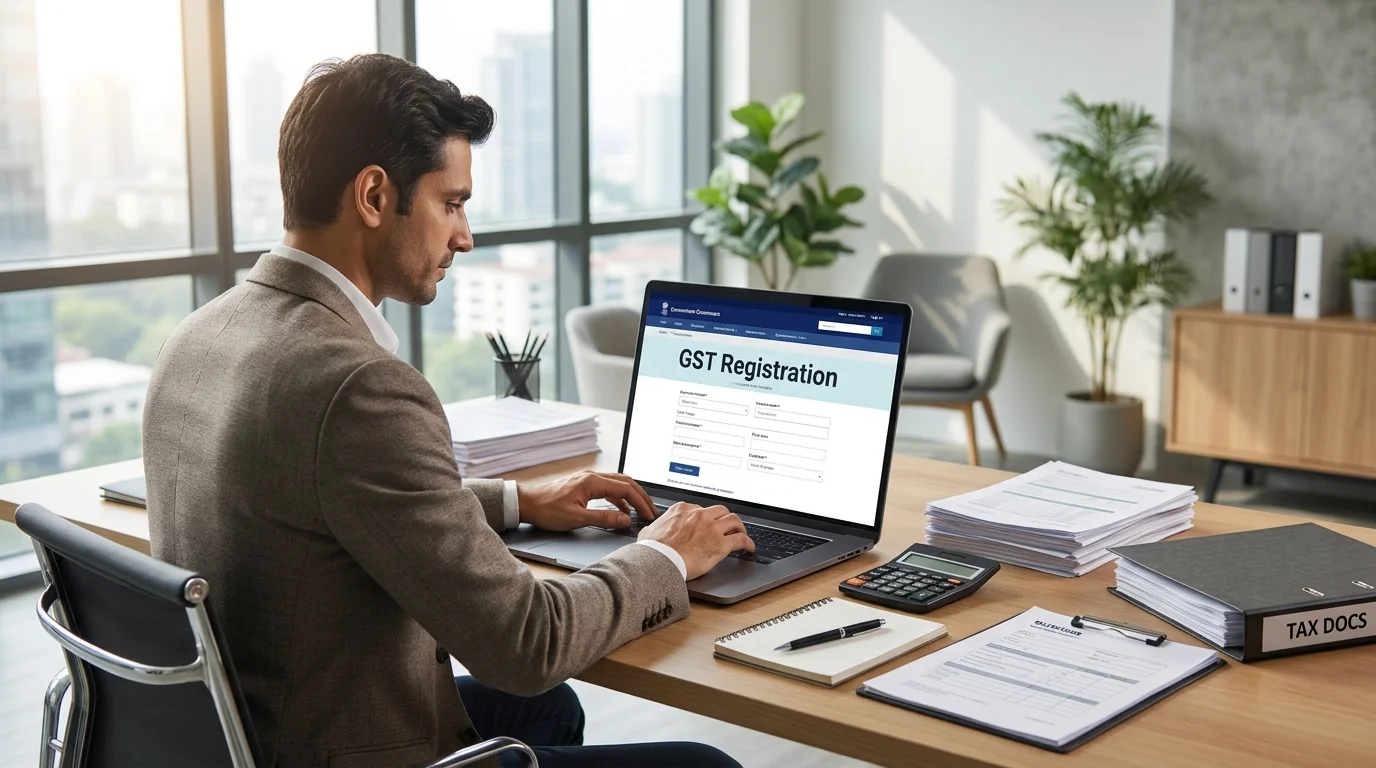
Open a GST/HST account once your worldwide taxable revenue passes 30,000 CAD across four consecutive calendar quarters. You can apply online, by phone, or by mail, and the CRA charges nothing for it. You then receive a nine-digit business number with an RT0001 suffix, and you have 29 days from your effective date to send the request.
The numbers that decide it
Four figures do most of the work. Miss one and you either collect tax you never owed, or hand the CRA money you forgot to charge your customers. That second one stings.
| What it is | The figure for 2026 | Why you care |
|---|---|---|
| Small supplier limit | 30,000 CAD | Cross it and registering stops being optional |
| Public service body limit | 50,000 CAD | Charities and non-profits get more headroom |
| Deadline to apply | 29 days | Counted from your effective date of registration |
| Cost to register | Nothing | No fee to open the account or to keep it |
| Quick Method limit | 400,000 CAD | Above it, you lose that simplified filing option |
| Account number format | 123456789 RT 0001 | Nine digits, then RT, then the account |
Key takeaways
- Register for a GST/HST account once worldwide taxable revenue tops 30,000 CAD.
- Taxi and ride-share drivers register from their first fare, whatever they earn.
- Businesses in Quebec apply to Revenu Quebec, which runs both taxes there.
- Nova Scotia dropped to 14% on April 1, 2025, so older rate charts mislead you.
- Voluntary registration lets you claim input tax credits on startup purchases.
- Late registration does not erase the debt. You still owe the tax you should have collected.
Who has to register, and who can wait
The test looks backwards, not forwards. Add up your worldwide taxable revenue over the last four consecutive calendar quarters. Stay under 30,000 CAD, and you count as a small supplier, so the account stays optional. Cross it. Now the clock starts.
That limit is not a CRA policy that drifts each year. It sits in subsection 148(1) of the Excise Tax Act. According to the Department of Justice Canada, that section fixes the limit at 30,000 CAD. The same subsection sets 50,000 CAD for a public service body, and the consolidated text carries a last-amended date of March 26, 2026. Your reporting periods hang off your year-end, and our guide to choosing a fiscal year in Canada explains how corporations and sole traders pick one.
Timing depends on how you crossed. Blow past the limit inside one calendar quarter, and your effective date is the day of the sale that took you over. Creep past it across four quarters instead, and your effective date is your first sale after you stop counting as a small supplier. Either way, CRA guidance gives you 29 days from that date to file. Input tax credits are claimed off supplier invoices, so it helps to have the accounts payable cycle set up properly from the start.
Two groups skip the test entirely. Taxi drivers and commercial ride-share drivers register from day one, even on 200 CAD of fares. Non-resident sellers who supply goods or digital products into Canada face their own rules under the digital economy regime.
Waiting is not always smart. A registered business claims input tax credits, which recover the tax it pays on laptops, tools, software, professional fees and any other purchase tied to taxable sales. Spend heavily in year one and voluntary registration can put real cash back in the bank. Our small business ownership guides walk through the trade-off in more detail. Registration is one step among several, and our guide on how to start a small business in Canada sets out the rest in order.
The catch is paperwork. Once you hold a GST/HST account, you file returns forever, even in quarters where you sold nothing.
How to complete your GST registration in seven steps
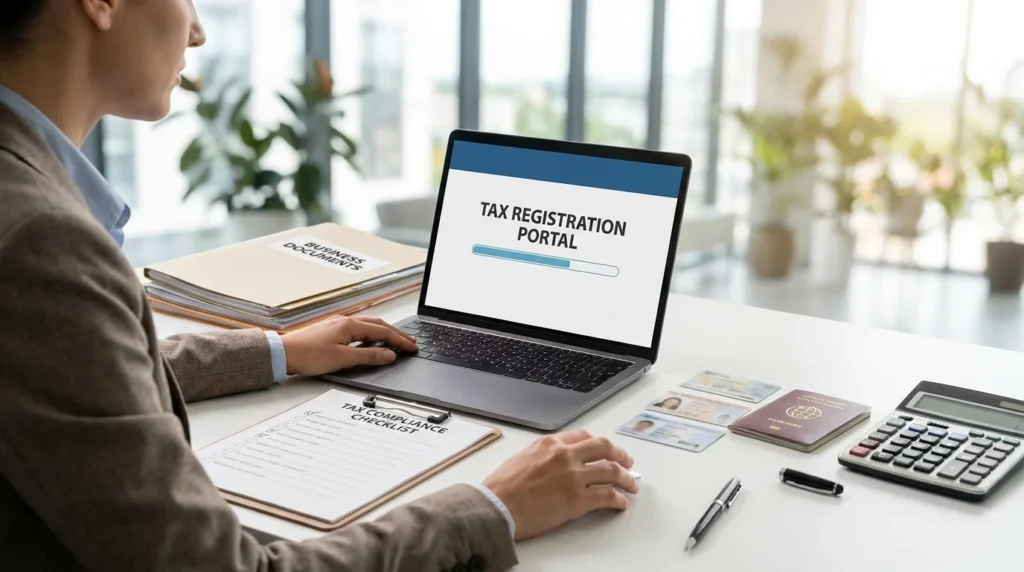
Gather this before you open the form, because Business Registration Online times out after ten minutes of inactivity:
- Your social insurance number, date of birth and postal code
- Your legal business name, structure and physical address
- The date you passed the limit, which becomes your effective date
- Your fiscal year end
- An estimate of total annual revenue, including zero-rated sales
- Run the four-quarter test. Total your worldwide taxable revenue over the last four consecutive calendar quarters and compare it against 30,000 CAD.
- Set your effective date. Use the day you stopped being a small supplier. Registering voluntarily instead? The CRA can backdate up to 30 days.
- Find or create your business number. Incorporated firms usually have one already. Sole traders often do not.
- Pick your fiscal year end. Most individuals and professional corporations use December 31, and a different year end needs CRA approval.
- Apply. Business Registration Online is fastest and issues the GST/HST number in the same session. Phone and mail both work, and mail is slowest.
- Save the number immediately. The CRA will not post it to you. Copy it, print the confirmation, then file it somewhere you can find it in a year.
- Update your invoices. Your account number has to appear on invoices, and you start charging from your effective date, not from the day the letter arrives.
Based in Quebec? Skip the CRA and apply to Revenu Quebec, which administers both the federal tax and the provincial QST for businesses in that province.
What you charge once you are registered

Rates follow the customer, not your office. Sell to an Ontario buyer from a Calgary desk, and you charge the Ontario rate. Five provinces fold the federal and provincial pieces into one harmonised rate. Three more run a separate provincial tax you may also have to register for. Quebec runs QST through its own agency. Rates vary by province, and our Canada sales tax calculator lists all 13 GST, HST and PST combinations for 2026.
| Province or territory | Federal rate you charge | Provincial tax on top |
|---|---|---|
| Alberta | 5% | None |
| British Columbia | 5% | 7% PST |
| Manitoba | 5% | 7% RST |
| New Brunswick | 15% HST | None |
| Newfoundland and Labrador | 15% HST | None |
| Northwest Territories | 5% | None |
| Nova Scotia | 14% HST | None |
| Nunavut | 5% | None |
| Ontario | 13% HST | None |
| Prince Edward Island | 15% HST | None |
| Quebec | 5% | 9.975% QST |
| Saskatchewan | 5% | 6% PST |
| Yukon | 5% | None |
Nova Scotia is the trap here. Its harmonised rate fell from 15% to 14% on April 1, 2025, and plenty of blog posts and checkout plugins never caught up. If you sell online across borders, our ecommerce and payments guides cover how carts handle this.
Choosing a reporting period and a filing method
Your reporting period arrives with the account, and it depends on size.
- 1,500,000 CAD or less in annual taxable supplies: annual filing, with monthly or quarterly available on request.
- Above 1,500,000 CAD and up to 6,000,000 CAD: quarterly filing, with monthly available.
- Above 6,000,000 CAD: monthly filing, no alternatives.
Annual sounds easiest. It rarely is, because twelve months of receipts land on your desk at once and any tax you collected has been spent by then. Many owners on the annual cycle file quarterly by choice, purely to keep the numbers small.
There is also the Quick Method, a simplified option that suits service businesses with few purchases and very little input tax to track each quarter. You still charge the full rate, then remit a lower flat percentage and keep the difference instead of tracking every input tax credit on each receipt you file. Eligibility caps at 400,000 CAD of worldwide taxable supplies including tax. The CRA also adds a 1% credit on your first 30,000 CAD of eligible supplies each fiscal year. We cover this in more depth in how Canadian fiscal years work.
Read More: SKU Meaning Explained
Mistakes that cost new registrants money

Most expensive errors happen in the first six months, before the routine sets in.
- Charging from the wrong date. Your duty starts on the effective date. Invoices you sent after it without tax still create a debt you now fund yourself.
- Spending the money. Tax you collect belongs to the CRA. Park it in a second account the day it lands.
- Forgetting the provincial layer. British Columbia, Saskatchewan and Manitoba run their own registrations, and a federal account does not cover them.
- Skipping nil returns. A quiet quarter still needs a filing.
- Losing the number. The CRA does not mail it, so a lost confirmation means a phone call.
- Ignoring pre-registration purchases. You can often recover tax on inventory and equipment you held on your effective date. Founders in our startups hub for new ventures miss this one constantly.
GST registration FAQ
No, not while your worldwide taxable revenue stays under that limit across four consecutive calendar quarters. You may still choose to register. Taxi and ride-share drivers are the exception and must register whatever they earn.
Business Registration Online usually gives you the number before you close the browser tab. Phone applications take about the same amount of time. Mailing form RC1 takes weeks, so use it only if the other routes are closed to you.
Not a cent. The CRA charges no fee to open or keep the account. Your only real cost is the bookkeeping time, or whatever you pay someone else to handle it.
Sometimes. Input tax credits can cover inventory, equipment and prepaid services you still held on your effective date. Keep those receipts and raise it with your accountant during your first filing.
The CRA backdates you to the effective date you should have used. You then owe the tax on every sale from that day, whether or not you charged it, plus interest and possible penalties. Fixing it early costs far less than waiting.