


You signed a contract, you invoice every month, and both sides call you an independent contractor. The CRA may still disagree. Status turns on how the work actually happens, not on the wording at the top of the agreement. Also worth reading: Droit De Douane au Canada.
A contractor in Canada runs a business of their own. They control how the work gets done, supply their own tools, may hire a helper, and stand to profit or lose on each job. Employees do none of that. The CRA first weighs what both sides intended, then tests six factors against what really happens. Contractors who decide to register a name will find the sequence in our guide on how to register a business in Ontario.
Employee or contractor: the fast answer
Two people can do identical work and hold different status. Control and financial risk separate them.
| Signal | Employee | Independent Contractor |
| Who directs the work | The payer sets method and hours | You choose method and schedule |
| Tools and equipment | The payer supplies them | You buy, insure and replace them |
| Sending a substitute | No | Usually yes |
| Financial risk | None | Real, including unpaid invoices |
| Chance of profit | Fixed pay | Rises and falls with your pricing |
| Overtime and leave rights | Yes, under provincial standards | No |
| CPP and EI | Split with the payer | You fund CPP in full, EI optional |
| Income reporting | T4 slip | Form T2125 with your T1 |
Read that table as a pattern. One row rarely settles anything, because the CRA looks at the whole relationship. If you are weighing the move off payroll, our small business ownership guides walk through the trade-offs.
Key takeaways
- Status follows how the work happens, not the label in the agreement.
- Intent comes first, then six factors running from control and tools through to the chance of profit.
- Quebec applies a three-step civil law test built around subordination.
- Self-employed CPP alone can reach 9,292.90 CAD in 2026, and GST/HST registration starts at 30,000 CAD.
- Misclassification bills the payer for back contributions and penalties, plus termination damages in bad cases.
- Form CPT1 buys a binding ruling from the CRA when the answer stays unclear.
How the CRA decides who is an independent contractor
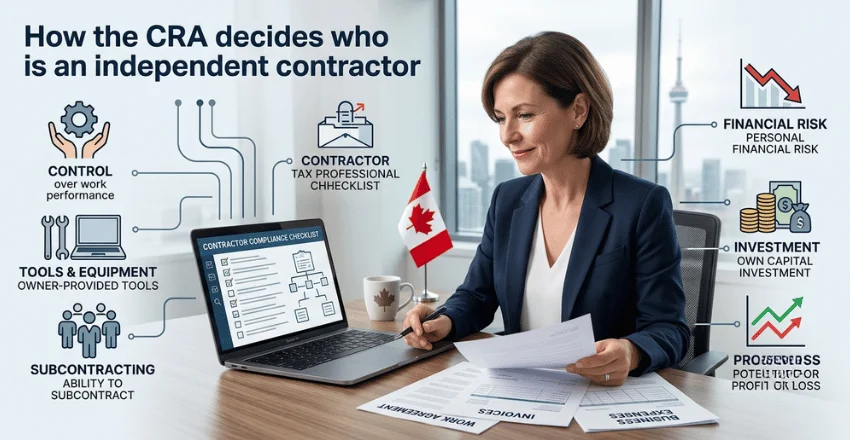
The CRA uses two steps. First, it considers whether both parties intended an Independent Contractor relationship. A signed agreement helps, but it does not decide the outcome.
Step two measures that intent against the working relationship. Six factors carry the weight.
- Control. Who decides when, where, and how the job gets done? Employers direct the method. Clients buy a result.
- Tools and equipment. Employees use what the payer hands them. Business owners buy, insure, and replace their own kit.
- Subcontracting and helpers. A contractor can send a substitute or hire an assistant. An employee cannot.
- Financial risk. Fixed monthly costs, expenses nobody reimburses, and invoices that go unpaid all point away from employment.
- Investment and management. Renting space, carrying liability cove,,r and choosing which jobs to take are business decisions.
- Chance of profit or loss. If sharper pricing or faster work lifts your margin, you are running a business.
No single factor wins. A worker with their own tools who still takes daily instructions on method usually lands on the employee side. You might also like our piece on employee scheduling templates.
Quebec runs a different test.
Civil law applies in Quebec, so the CRA follows a three-step approach there. After intent, it asks whether the worker performs work, whether remuneration flows, and whether a relationship of subordination exists.
Subordination is the pivot. Where the payer holds authority to direct and supervise, Quebec law reads an employment contract, whatever the paperwork says.
The 2026 numbers a contractor should budget for
Self-employment is no fringe arrangement here. A Statistics Canada study counted 2,652,600 self-employed workers in 2023, or 13.2% of everyone working in the country. Each one carries costs an employee never sees.
| CPP maximum pensionable earnings | 74,600 CAD | Ceiling for base contributions |
| CPP basic exemption | 3,500 CAD | First slice, no contribution |
| Self-employed CPP rate | 11.90% | Both halves fall on you |
| Maximum CPP contribution | 8,460.90 CAD | Paid with your T1 |
| Second CPP ceiling (CPP2) | 85,000 CAD | Applies above 74,600 CAD |
| Maximum CPP2 contribution | 832 CAD | On top of the base amount |
| GST/HST registration threshold | 30,000 CAD | Taxable revenues, rolling test |
Add those together, and the CPP bill alone reaches 9,292.90 CAD before a single income tax instalment. Employees split that cost with a payroll department. You do not.
Register for GST/HST once taxable revenues pass 30,000 CAD, either in one calendar quarter or across four consecutive quarters. Business income goes on form T2125 with your personal return, and self-employed filers get until June 15 to file, though any balance owing falls due April 30. Most contractors operate as sole proprietors, and our sole proprietorship Ontario guide covers the 2026 taxes, registration cost and GST/HST rules.
What misclassification actually costs

Federal law is blunt about this. Section 167.1 of the Canada Labour Code prohibits an employer from treating an employee as if they were not their employee. Labour Program guidance published in 2021 goes further, presuming that a person paid for work counts as an employee until the employer shows otherwise.
Get it wrong, and the bill lands on the payer.
- Back CPP contributions and EI premiums for both halves, plus interest.
- Penalties from the CRA on the amounts nobody remitted.
- Unpaid overtime, statutory holiday pay and annual leave pay under provincial employment standards.
- An administrative monetary penalty, which the Labour Program illustrates with a 3,000 CAD example.
- Termination damages if a court later reads the relationship as employment.
Workers carry risk too. A contractor the CRA later reclassifies loses deductions claimed on past returns, and the reassessment can reach back several years.
Dependent contractors sit in the middle.
Canadian courts recognise a third category the CRA does not use. A dependent contractor bills like a business but earns nearly all of their income from one client over a long stretch. That economic dependence buys something valuable.
Reasonable notice. Courts have handed dependent contractors notice periods close to what a comparable employee would get, sometimes running to many months, so a long single-client relationship deserves a careful read.
Should you incorporate?
Incorporating looks like the obvious upgrade. It can be a trap. Where you would be an employee of your client but for the corporation, the CRA can label the company a personal services business.
That label hurts. Such a company loses the small business deduction and the general rate reduction, and it pays an extra 5% federal tax on top. Deductible expenses shrink to little more than the salary it pays the worker. The CRA ran a pilot on these companies, and in phase two it confirmed 291 of them, roughly 84% of which had claimed a small business deduction they could not use.
- Incorporate when you hold several clients, real staff and genuine business risk.
- Think twice when one client provides nearly all of your income.
- Ask an accountant before the first invoice, not after the first reassessment.
More explainers on business structures and filings sit in the Bizverra journal.
How to get a binding answer from the CRA
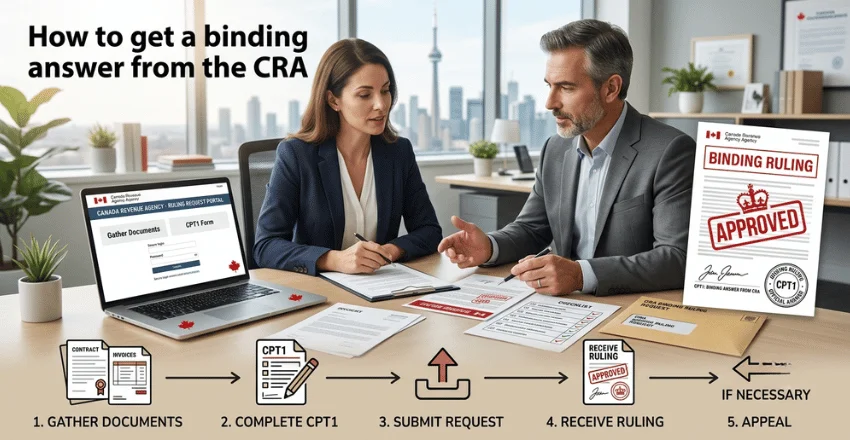
Guessing is optional. Either side can ask the CRA to rule on a working relationship, and that ruling binds the agency.
- Gather the written agreement and every invoice, plus anything showing who controls the work.
- Complete form CPT1, the request for a CPP/EI ruling.
- Send it to your tax services office or file it through the CRA online portal.
- Ask by June 29 of the year after the year the question relates to.
- Appeal to the Minister within 90 days if the answer goes against you.
Rulings take time. Start early in the relationship rather than after a dispute.
Your next step
Take the six factors and write down which ones you could prove with documents control, tools, substitution, risk, investment, profit. If fewer than half survive that test, fix the arrangement now, while it is cheap, rather than after a reassessment lands on the desk.
Frequently asked questions
Yes, for CRA purposes. Both describe someone running a business rather than holding a job. Provincial employment standards and the courts use narrower definitions, which is why one worker can be self-employed for tax and an employee for termination rights.
Nothing forces one, but write it anyway. Intent is the first thing the CRA looks at, and a signed agreement gives the clearest evidence of it. Spell out control, tools, substitution rights, and payment terms.
No premiums come off self-employment income. Contractors may opt into EI special benefits for parental, sickness, and caregiving leave, though that choice carries its own rules and a waiting period.
Reasonable costs of earning business income. Home office space, software, insurance, professional fees, and the business share of a vehicle all qualify. Keep receipts for six years, and leave personal costs off the return.
Only where the work genuinely changes. Handing the same person the same duties under a new invoice arrangement is the classic misclassification pattern, and the presumption in the Canada Labour Code works against the employer.