

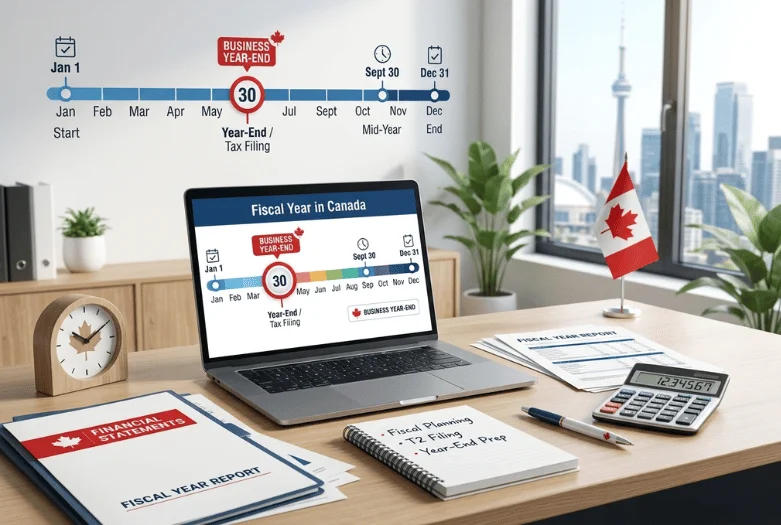
Most Canadian founders never choose a fiscal year. They inherit December 31, then find that the stock count, the busiest trading weeks, and the accountant’s diary all collide. Your reporting period is a genuine decision, and CRA hands corporations far more room than sole traders get. Here is what the rules actually allow. Elsewhere on the site: Virtual Office With Live Receptionist in Canada.
Short answer: a fiscal period is the stretch of trading a business reports on, and it does not have to match the calendar. A corporation may end it on any date it likes, as long as the period runs no longer than 53 weeks. Sole traders report to December 31 unless they elect otherwise.
Who gets to choose a year end?
Your business type decides how much freedom you have. Corporations pick their own date. Individuals mostly inherit one.
| Corporation | Set on the first T2 return | Yes, any date | 53 weeks |
| Sole trader | December 31 | Only by electing the alternative method | 53 weeks |
| Partnership of individuals | December 31 | Only by electing the alternative method | 53 weeks |
| Professional corporation inside a partnership | December 31 | No | Twelve months |
| Federal government | March 31 | Not applicable | Twelve months |
Key takeaways
- A corporation may close its fiscal period on any date, up to 53 weeks after the period began.
- Sole traders and most partnerships report to December 31 unless they elect the alternative method on Form T1139.
- The T2 return falls due six months after the period ends.
- Corporate tax is payable at two months, or three for a CCPC claiming the small business deduction.
- Changing the date later needs written approval from a tax services office.
- Ottawa closes its own books on March 31.
What a fiscal year means to CRA
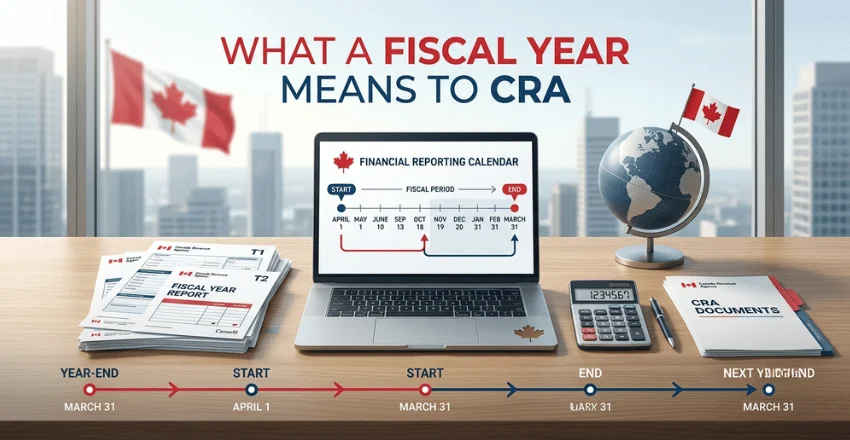
CRA rarely uses the phrase fiscal year. Its forms say fiscal period, and for a corporation, the tax year is simply that period. Calendar years run January 1 to December 31. A fiscal period can close on the last day of whichever month you nominate.
Everything downstream keys off that one date. Return deadlines, instalment schedules, the annual GST/HST filing and the statements your bank asks for all count forward from the day you close the books.
Choose badly, and you pay for it every year in scramble. Choose well and the count, the paperwork and your quiet season line up. Founders still working through the wider set-up decisions will find more in our small business ownership guides.
Corporations get 53 weeks.
According to section 249.1 of the Income Tax Act, a corporation’s fiscal period cannot end more than 53 weeks after it began. The CRA sets the same limit at 371 days. That ceiling is the only hard rule in the whole choice.
You set the date on your first T2 return. The clock starts at incorporation, so a company formed on March 3, 2026 could run its first books to February 28, 2027. Each later tax year then begins the day after the previous one closed.
- A professional corporation inside a partnership must close on December 31.
- A short first period is normal, and often deliberate.
- CRA prorates the small business limit across a period under twelve months.
Sole traders and partnerships stop at December 31
Different rule here, and it catches people out. Sole traders, plus partnerships whose members are all individuals, report business income on a calendar-year basis. December 31 is the default, and for most people that is the end of the matter.
An exit does exist. The alternative method lets an eligible sole trader keep a non-calendar fiscal period, provided the business trades in Canada and no partner is a corporation. You file Form T1139, Reconciliation of Business Income for Tax Purposes, alongside the return, and you file it again for every year you stay on the method. Tiered partnerships and tax shelter investments do not qualify. For a closer look at this, see fiscal year in Canada.
How to pick a year-end that suits the work
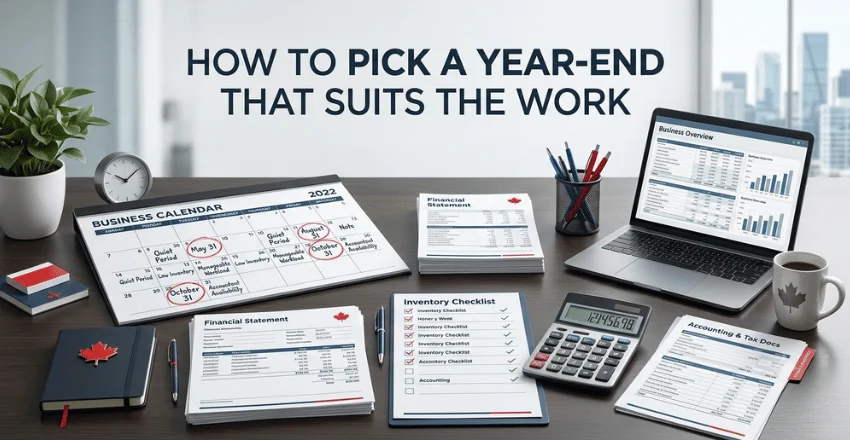
Start from the calendar you already live by, not from tax.
- Pick the month when stock sits at its lowest, so the count is quick.
- Stay clear of your busiest trading weeks.
- Check when receivables clear, so the figures you report are real.
- Ask which months your accountant has capacity; many are swamped from February to April.
- Weigh whether a later year end defers the first tax bill.
Here is a worked example. A Winnipeg garden centre trades hard from April to September, then goes quiet. Shelves sit near empty in late autumn, and the owner has time in November. A September 30 year-end puts the inventory count in those quiet weeks and the tax filing in March, well clear of the spring rush.
Deadlines that follow from the year-end
Pick a date and the deadlines follow on their own. Below, they are worked through for a company that closes on June 30.
| T2 corporation return | Six months after the period ends | December 31 |
| Corporate balance owing | Two months after the period ends | August 31 |
| Balance, CCPC claiming the small business deduction | Three months after the period ends | September 30 |
| Annual GST/HST return and payment | Three months after the period ends | September 30 |
| Sole trader T1, December 31 period | Pay first, file second | April 30 and June 15, 2026 |
That longer window belongs to a Canadian-controlled private corporation claiming the small business deduction, which covers the first 500,000 CAD of active business income. Everyone else pays at two months. Miss the T2 date, and CRA adds a late-filing penalty on top of interest already running.
Changing a year-end later
CRA treats a change as a request, not a notification. Write to your tax services office before the current period closes, give the effective date, and set out the business reason. Requests built purely around deferral tend to fail. Four situations skip the approval step entirely:
- Winding up the company and filing a final return.
- A change of control under section 249(4) of the Income Tax Act.
- Becoming, or ceasing to be, a Canadian-controlled private corporation.
- Gaining or losing tax-exempt status.
GST/HST and Ottawa’s own calendar
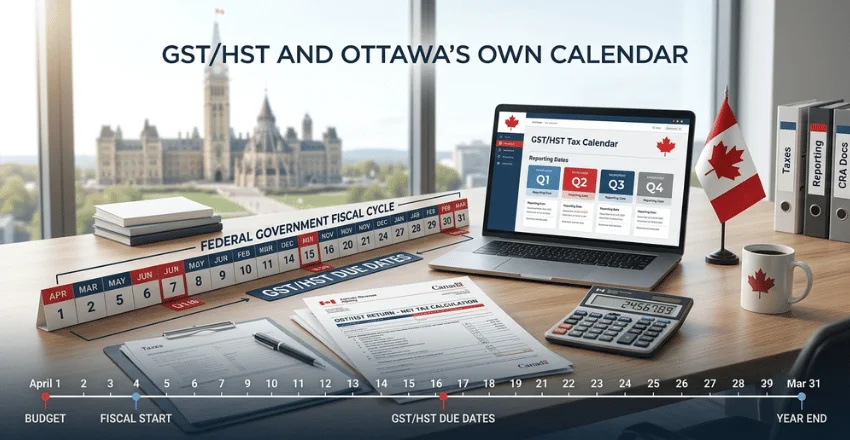
Your GST/HST fiscal period normally mirrors the income tax one, though the two are not welded together. Annual filers can ask CRA to shift the GST/HST period on its own, and that request sits with your GST/HST account rather than the T2 file.
Ottawa runs to a different rhythm. The federal government closes its books on March 31, which is why grant programs, funding rounds and the public accounts quote dates from April 1 to March 31. Miss that, and a funding application can land in the wrong reporting cycle. More explainers on the numbers side sit in the Bizverra journal.
Your next step
Write down three candidate months. Test each one against your stock count, your quiet weeks and your accountant’s diary, then lock the pick in before you file that first return. Changing it afterwards costs a letter, a wait and a reason the CRA will accept.
Apart from that, if you want to know more about Canadian Paycheque then visit our Entrepreneurship category.
Frequently asked questions
Yes, with permission. A corporation writes to its tax services office and explains the business reason behind the move. Approval never comes automatically, and a request shaped only around deferral usually fails.
No. Short first periods are common, and 53 weeks marks the outer edge. Plenty of companies close early in year one to line the books up with a month that suits them.
March 31. Ottawa’s books run from April 1 to March 31, and departmental reporting follows those same dates.
You elect it rather than ask for it. File Form T1139 with your return, meet the conditions, and refile the form for each year you keep the method.
Six months after the period ends. Close on March 31 and you file by September 30. Close on December 31 and you file by June 30. Payment lands earlier than filing, so treat the balance-due day as the real deadline.