


Your best-selling hoodie arrives in four colors and five sizes. Those are twenty separate things to count, pick, and reorder, and one product name cannot tell them apart. A SKU can, and building a sensible one takes an afternoon.
What a SKU is, in plain terms
A stock keeping unit is a short internal code that you assign to one exact sellable version of a product: one style, one color, one size, and one pack. You invent it, you own it, and you can change it. Nobody outside your business needs to recognize it.
The gap between your own code and a scannable barcode number trips up most new sellers. One belongs to you. The other belongs to a global register that you pay to join.
| Identifier | Who assigns it | Format | Typical length | What it is for |
|---|---|---|---|---|
| SKUs | You, the seller | Letters and numbers | 8 to 16 characters | Counting, picking and reordering inside your business |
| UPC | GS1, on a licensed company prefix | Digits only | Exactly 12 digits | Scanning at any checkout in North America |
| GTIN | GS1 | Digits only | 8, 12, 13, or 14 digits | The global umbrella number, a UPC, is a GTIN-12 |
| Barcode | Your software, or GS1, | Printed symbol | Not applicable | Making either number machine-readable |
Read the table sideways, and the pattern shows up: you control the top row and rent the rest.
Key takeaways
- A stock keeping unit names one sellable variant, never a product family.
- Build codes from segments, widest attribute first: category, then style, then color, then size.
- Cap the length at 16 characters and give every segment a fixed width.
- Never reuse a retired code.
- Your own codes are free. A retail barcode number is not, because GS1 Canada licenses the company prefix inside it.
Why product codes carry more weight than the product name

Two sales, same hoodie, different sizes. Your shop counts them as one line if the name is all you have. Stock drifts within a week, and the reorder is wrong too.
Codes also travel. Courier labels, purchase orders, and marketplace listings can all carry the same string, so one search finds every trace of an item. Sellers running a storefront alongside a market stall feel this first, and our e-commerce and online retail guides cover the same ground from the shopfront side.
One more job they do: they make a catalog sortable. Sort your product list, and every winter jacket sits together; every color of that jacket sits together under it, and the sizes run in order. That only works if the segments sit in the right sequence position, which is the part page one tends to skip.
How to build a scheme in six steps
Work from the widest attribute down to the narrowest. Nothing else about the design matters as much.
- List your variants. Write out every attribute that changes what you physically pick off a shelf: category, style, color, size, and pack quantity.
- Rank them. Category first, then style or brand, then color, then size. Widest to narrowest, always.
- Fix a width for each segment. Three characters for category, four for style, three for color, and two for size. Fixed widths are what keep a sorted list tidy.
- Choose readable abbreviations. BLK beats 01 for black, because a picker holding a label should not need a lookup sheet.
- Add a serial only where you need one. A two-digit counter handles genuine duplicates without turning the code into a phone number.
- Write the rules down. One page, stored beside the product list, naming every segment and every abbreviation you have used.
Do that once, and the scheme scales quietly. Adding a color next season means adding one abbreviation, not redesigning anything.
A worked example: Riverdale Outfitters
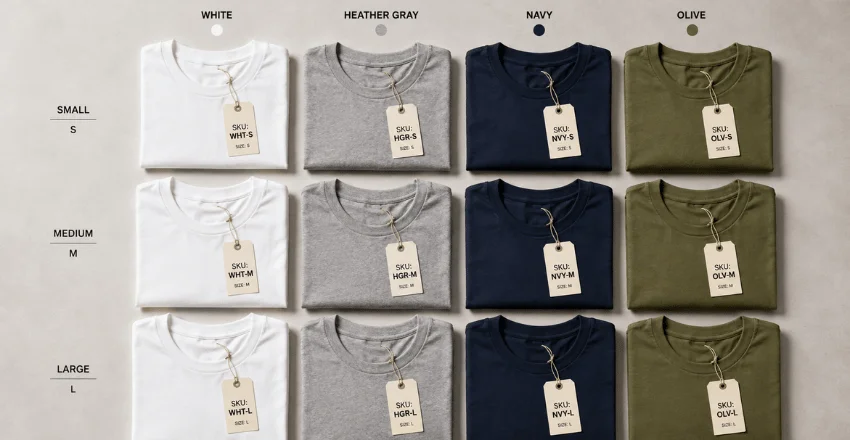
Riverdale Outfitters is an invented Ontario retailer selling outdoor clothing, and it carries roughly 340 sellable variants. This is the scheme it settled on.
| Segment | Width | What it holds | Example |
|---|---|---|---|
| Category | 3 | Product group | JKT |
| Style | 4 | Model or style name | ASPN |
| Colour | 3 | Colour abbreviation | GRN |
| Size | 2 | Size abbreviation | MD |
Combine those, and the medium green Aspen jacket becomes JKT-ASPN-GRN-MD. The same jacket in slate grey is JKT-ASPN-SLT-MD, and the two sit beside each other in any sorted list. Both hang on the rail at 189 CAD.
Riverdale buys from three suppliers, and each one uses its own part numbers. Those live in a separate column, mapped to the internal code, and are never merged into it. Supplier numbering changes when a supplier changes, and yours should not. Buyers untangling the same problem in a wholesale setting will find more in our B2B selling and supplier guides. Internal SKUs are not customs codes: cross-border shipments need an HS code, and our guide explains how to verify the one a supplier gives you.
Rules that keep the catalogue clean
Most schemes fail on maintenance rather than design. Six habits prevent that.
- Cap the length. 16 characters is plenty, and anything longer gets truncated by a label printer or a marketplace field.
- Skip lookalike characters. The letter O and the digit 0 cause mispicks, and so do I and 1.
- Start with a letter. A code beginning with a digit invites spreadsheet software to read it as a number, and leading zeros get stripped the moment the file reopens.
- Use one separator. A hyphen everywhere, or none at all.
- Never reuse a retired code for a different product. Old orders, old returns, and old counts all still point at it.
- Keep private data out. Supplier names and buying margin do not belong in a string a customer can read.
What Canadian sellers run into
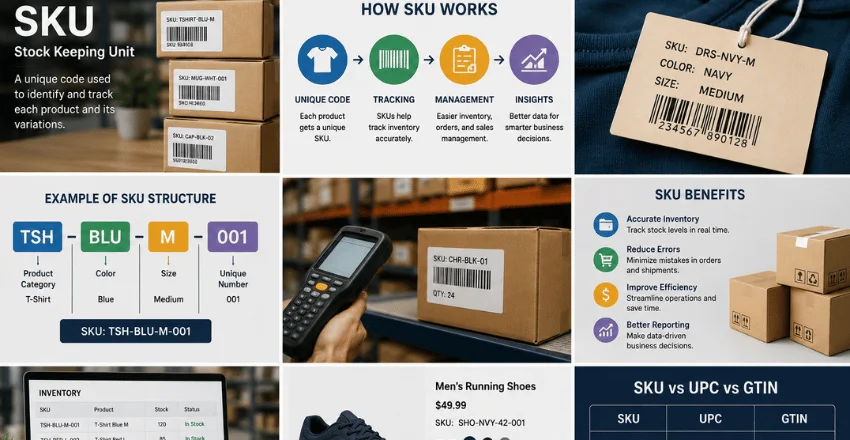
A scannable retail barcode is not free, because the digits inside it come from a licensed company prefix, and in this country GS1 Canada issues those prefixes. Sell only through your own shop, and you may never need one.
Bilingual catalogues cause the second stumble. Sold as “Winter Jacket” in English and “Manteau d’hiver” in French, one jacket is still one item with one code. The language lives in the description field, never inside the code itself. Translating a segment breaks every sort you have.
Warehousing across provinces adds a third. An Ontario stockroom and a British Columbia stockroom holding the same jacket should show the same code, with location tracked as its own separate field. Splitting the code by site is the mistake, because it doubles your product list overnight and hides the true count.
None of this needs software. A spreadsheet holds a scheme fine up to roughly a thousand variants, and plenty of small businesses run that way for years. Founders weighing up when to upgrade will find related reading in our small business ownership guides.
Pick one product family and code it this week. Twenty minutes with a spreadsheet gives you the segment widths, and the rest of the catalog follows the same pattern. Then write those rules on one page, so the next person you hire does not quietly invent a second scheme alongside yours.
FAQs
Stock Keeping Unit. Say it as “skew,” not as three letters.
Eight to sixteen suits most catalogs. Shorter than eight and you run out of room for segments. Longer than sixteen and labels start truncating, which defeats the point of printing them.
No. You write one, GS1 sells the other. Every UPC carries exactly 12 digits and works at any checkout in North America, while your internal code works only inside your own business.
Usually on the price ticket or the packing label, printed under or beside the barcode. Online, it tends to sit in the product details block of a listing, near the size and color options.
Past about thirty variants, yes. Below that, you can hold the whole list in your head. Above it, mistakes creep into the counting rather than the selling, and they surface as phantom stock.
Never, even when they look identical on the shelf. Two pack sizes of the same sauce are two sellable variants, so they take two codes. The moment a customer can choose between them, your counting has to as well.
Reusing a retired code, mixing separators, and burying supplier part numbers inside your own scheme. Each one costs an hour of untangling later.