
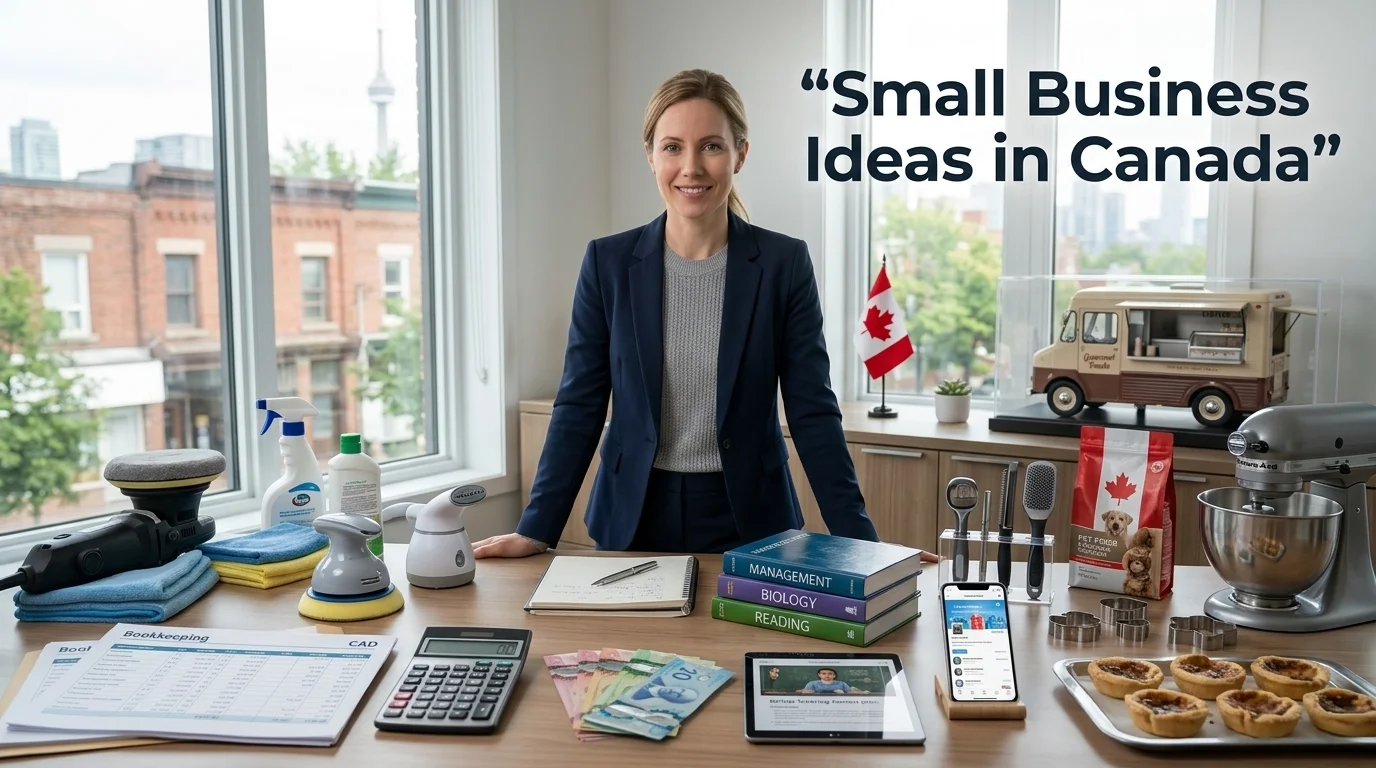
You have a weekend, roughly 3,000 CAD, and a shortlist you keep rewriting. Most small business ideas fail on cost long before they fail on demand. A few fail on paperwork nobody warned you about. This page prices 12 of them for a Canadian founder.
The fastest starts here are service businesses: cleaning, mobile detailing, bookkeeping and tutoring. Each one opens under 2,500 CAD, clears its paperwork in weeks, and can invoice inside a month. Regulated choices such as home daycare, food trucks, and trades work cost far more, and they wait months for approval before a single customer arrives. If Ontario is where you are launching, our guide on how to start a business in Ontario covers what to register, pay and set up first.
What each idea costs to start in Canada
The ranges below are cash out the door in the first month: equipment, insurance, registration plus a month of supplies. They assume you work alone, from home where the rules allow it. City by city the numbers move, so read them as a planning range and not a quote.
| Idea | Startup cost (CAD) | Licence or permit | Time to first revenue |
|---|---|---|---|
| House cleaning | 1,000 to 2,500 | Municipal business licence in many cities | 2 to 4 weeks |
| Bookkeeping | 500 to 2,000 | None; certification optional | 2 to 6 weeks |
| Online tutoring | 300 to 1,500 | None | 1 to 3 weeks |
| Social media management | 500 to 2,500 | None | 2 to 6 weeks |
| Pet sitting and dog walking | 500 to 2,000 | Municipal pet care licence in some cities | 1 to 4 weeks |
| Print on demand store | 500 to 3,000 | None | 3 to 8 weeks |
| Mobile car detailing | 2,000 to 6,000 | Municipal licence plus water bylaw rules | 3 to 6 weeks |
| Handyperson service | 2,500 to 9,000 | Trade certification for electrical and plumbing work | 2 to 6 weeks |
| Lawn care and snow clearing | 3,000 to 12,000 | Municipal licence; contractor registration in some provinces | 2 to 8 weeks |
| Home bakery | 2,000 to 8,000 | Public health approval and a food handler certificate | 4 to 10 weeks |
| Home daycare | 3,000 to 15,000 | Provincial licence above the unlicensed child limit | 2 to 6 months |
| Food truck | 60,000 to 120,000 | Municipal vending licence and a health permit | 3 to 6 months |
Key takeaways before you pick one
- Six of the 12 options open under 2,500 CAD and need no provincial licence at all.
- Food, children, and trades work always carry a licence, an inspection, and a wait.
- Register for GST/HST once taxable revenue passes 30,000 CAD across four consecutive quarters.
- BizPaL lists every permit tied to your own address, across all three levels of government.
- Time to first revenue decides whether you survive the launch, not market size.
HoHome-basedptions under 2,500 CAD

Cleaning is the plainest business on the table. Two hundred CAD of supplies, a vehicle you already own, and a route of eight regular homes will cover a part-time income by the second month. Pricing sits between 35 and 60 CAD per hour in most Canadian cities, and repeat work arrives without advertising once three clients refer you.
Bookkeeping asks more of you up front and pays it back. Software runs about 40 CAD a month, and a certificate helps you win the first three clients, though no province requires one to keep books for a sole trader.
Then there are the ideas that need nothing but time:
- Online tutoring, where a subject you already know earns 30 to 70 CAD an hour.
- Social media management for local trades, usually sold as a 600 CAD monthly retainer.
- Pet sitting, which fills fast in dense neighbourhoods and slowly everywhere else.
None of these are glamorous. They are, however, the ones that reliably reach revenue inside a month, and our small business ownership guides go deeper on running them once clients arrive.
How to judge an idea before you spend
Ask what the first 1,000 CAD buys. If it buys tools that earn on day one, the idea is sound. If it buys inventory and a logo, you are funding a hobby.
Scale is a poor filter here. Statistics Canada reported that businesses with 1 to 19 employees represent 91.1% of all employer businesses in Canada. A tiny operation is the normal outcome, not the failed one. Aim at a market you can serve alone. Our startups hub for launching a venture covers what changes when you hire.
Test demand before the spend. Post the service at your real price, tell forty people in your postal code, and count who books rather than who says it sounds great. Two paying customers in a fortnight is a signal. Zero is also a signal.
Small business ideas that need a licence first

Licensing in Canada sits at three levels, and a founder usually meets all three. Municipalities issue the general business licence, provinces regulate the occupation, and Ottawa handles anything crossing a border.
Four categories reliably trigger a permit:
- Food handling. A home bakery or truck needs public health approval of the kitchen plus a food handler certificate for whoever cooks.
- Home daycare. Every province caps how many children you may mind unlicensed, commonly five or six including your own. Above it, you need a provincial licence.
- Trades work. Electrical, gas fitting and plumbing require a certified journeyperson. Painting and general repairs do not.
- Personal care. Provinces inspect nail bars, lash studios and massage clinics, and the rules differ sharply between them.
Run your address and activity through BizPaL, the joint federal, provincial and municipal permit finder. It takes four minutes, and it names the exact licences your city wants, which beats guessing from a national blog post.
Registration and the 30,000 CAD GST/HST threshold
Registration is cheaper than founders expect. A sole proprietorship costs roughly 60 to 80 CAD to register provincially, and incorporation runs 200 to 350 CAD federally. Neither is the decision that matters most in year one.
GST/HST is. You may operate as a small supplier, collecting nothing, until taxable revenue passes 30,000 CAD over four consecutive calendar quarters. Cross it, and you must register, charge the rate for your province, and file. Many founders register voluntarily before the threshold anyway, because input credits refund the GST/HST paid on equipment and supplies.
Selling online without a storefront

Print-on-demand and handmade goods behave differently from services. Revenue lags because traffic has to exist before an order does, and a first sale at week six is normal rather than alarming.
Three costs surprise people:
- Shipping inside Canada, which often exceeds the product margin on light items.
- Payment processing at roughly 2.9% plus 30 cents per transaction.
- Returns, which land at 5 to 15% for apparel and near zero for stationery.
Price for those three before launch, not after the first refund. Our ecommerce and payments guides break down the processing side properly.
Our verdict: the one we would start first
Bookkeeping is our pick for 2026. It needs 500 to 2,000 CAD and no licence in any province. Billing is monthly rather than per job, which smooths the cash gaps that sink new service firms in their first winter. Cleaning is the better choice if you would rather work with your hands, and it reaches revenue a fortnight sooner. Skip the food truck unless you have run a kitchen. The permits alone take a season.
Your next step

Pick two options from the table. Price them properly for your own city, run both through BizPaL, and start the one that reaches its first invoice soonest.
FAQ
Online tutoring. It needs 300 to 1,500 CAD, no licence, and no premises, and a first paying student can arrive in a week.
Local services. Cleaning and mobile detailing both invoice within four weeks, because the customer books, receives the work, and pays on the same visit.
Usually yes. Most Canadian municipalities require a home occupation licence, typically 50 to 200 CAD a year, even for quiet office work with no visitors.
No. Registration becomes mandatory once you pass 30,000 CAD in taxable revenue over four consecutive quarters, though voluntary registration is allowed earlier.
Around 30 to 120 CAD, depending on the province and the course provider. Most run online and take a single afternoon.