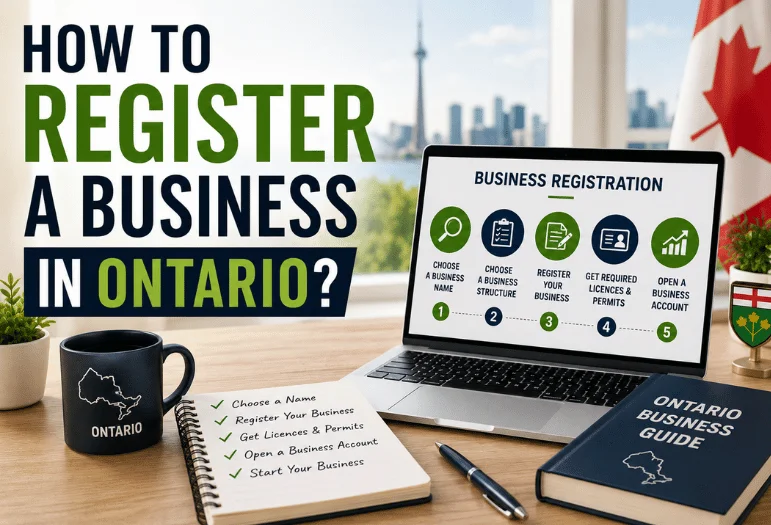


How to Start a Business in Ontario is less about completing one form and more about making several decisions in the right order. You need to choose the right ownership structure, complete provincial registration where required, set up tax accounts, obtain necessary permits, organize your financial records, and prepare for employees if you plan to hire.
To start a business in Ontario, validate your idea, choose a legal structure, check your business name, register where required, set up CRA accounts, confirm licences and permits, separate your finances, arrange insurance, and complete employer registrations before hiring. Online registrations can be processed quickly, while fees vary by business type.
Ontario Business Setup at a Glance
| Setup item | What to know in 2026 |
| Ownership structure | Ontario recognizes sole proprietorships, partnerships, corporations, and co-operatives. |
| Sole proprietorship registration | $60 when registration is required. |
| General partnership registration | $60. |
| Ontario business corporation | $300 to incorporate through the provincial registry. |
| Ontario identifier | The province issues a Business Identification Number, or BIN. It is different from a CRA Business Number, or BN. |
| GST/HST | Most ordinary businesses can remain unregistered while they qualify as small suppliers under the $30,000 threshold. Voluntary registration is also possible. |
| Licences and permits | Requirements depend on your location and business activities. Ontario recommends BizPaL for a customized list. |
| First employee | Most businesses that require WSIB coverage must register within 10 calendar days of hiring their first employee. |
What You’ll Need Before You Register

Have your ownership decision and proposed business name ready before you begin. For online registration in Ontario, you’ll also need a working email address and a valid debit or credit card.
You should also know your business address, what you plan to sell, where you’ll operate, whether you expect to hire employees, and roughly how much taxable revenue you expect to earn. These details can affect your tax accounts, permits, insurance, and employer obligations.
How to Start a Business in Ontario: 9 Steps
1. Validate Your Business Idea
Start with the customer rather than the registration form.
Identify who will buy from you, the problem you solve, your likely competitors, your expected pricing, and the cost of delivering your product or service. Ontario’s startup process also encourages entrepreneurs to begin with market research and a business plan.
Your plan doesn’t need to be lengthy. A practical first version should cover your offer, target customer, sales approach, startup costs, monthly expenses, and a basic revenue goal.
2. Choose the Right Ownership Structure
Your business structure affects liability, taxes, administration, ownership, and future financing. Ontario recognizes four main options.
| Structure | Ownership | Liability | Administration | Often suitable for |
| Sole proprietorship | One owner | The owner is personally responsible for business debts | Lowest setup complexity | Freelancers and small owner-operated businesses |
| Partnership | Two or more owners | Partners may be responsible for business debts | Relatively simple | Businesses with multiple active owners |
| Corporation | Separate legal entity | Generally separates corporate liabilities from the owners | More filings and recordkeeping | Businesses seeking liability separation, investment, or growth |
| Cooperative | Member-owncorporation | Structured separately from its members | More formal governance | Member-controlled ventures |
A sole proprietorship is one of the simplest structures for starting a business in Ontario. However, the owner is personally responsible for the business’s debts and losses.
A corporation costs more to establish and involves additional filing and recordkeeping requirements. Choose your structure based on risk, ownership, tax considerations, and growth plans rather than the registration fee alone.
3. Check and Choose Your Business Name
Search the Ontario Business Registry before building a brand around a particular name. This can help you determine whether a proposed name is already being used.
If you’re incorporating an Ontario corporation under a word name rather than a numbered name, you may also need an Ontario-biased or weighted NUANS name search report. The report is obtained from a private name-search provider, so its cost is separate from the provincial incorporation fee.
A sole proprietor operating only under their legal name may not need to register a separate business name. Registration is generally required when a sole proprietor operates under another business name.
4. Register Through the Ontario Business Registry
Businesses that require provincial registration can complete the process through the Ontario Business Registry.
Current provincial registration fees include:
- Sole proprietorship: $60
- General partnership: $60
- Ontario limited partnership: $210
- Ontario business corporation: $300
Ontario lists online registration for sole proprietorships and general partnerships as an immediate service. Online incorporation of an Ontario business corporation is also listed as immediate.
Once registered, keep your provincial records secure. Ontario businesses may receive a nine-digit Business Identification Number, or BIN. A company key is used to secure access to a business’s registry profile and should also be kept private.
5. Set Up the CRA Accounts You Need
Don’t confuse your Ontario BIN with your CRA BN. They are separate identifiers.
A CRA Business Number may be required when you need a GST/HST, payroll, or another CRA program account, or when you incorporate. In some situations, a business number may be issued during the provincial registration or incorporation process, so check whether you already have one before applying again. If you are running unincorporated, our Ontario sole proprietorship guide explains the tax treatment and when incorporating starts to pay.
For most ordinary businesses, the GST/HST small-supplier threshold is $30,000. If your taxable revenue remains below the applicable threshold, you may not need to register for GST/HST, although voluntary registration is possible.
Different rules may apply if you exceed the threshold within a single calendar quarter or operate under a business type subject to special rules.
CRA’s Business Registration Online service now requires access through a CRA account, so make sure you can sign in before beginning the registration process.
6. Check Every License and Permit

Provincial registration does not automatically give you every approval needed to operate. Depending on your business, you may need municipal, provincial, or federal licenses and permits. Requirements often depend on your location, industry, and specific business activities.
BizPaL is a free tool that can help you identify permits and licenses that may apply to your business. Complete this check before signing an expensive lease, renovating a commercial property, or purchasing specialized equipment.
7. Set Up Banking and Bookkeeping
Create a system that separates business activity from personal spending as early as possible.
A dedicated business bank account can make income and expenses easier to track. You should also establish a clear process for managing invoices, receipts, sales tax, expenses, and supporting records.
If your business is incorporated, maintaining clear financial separation is even more important because the corporation is a separate legal entity.
Set aside money for taxes instead of treating every payment you receive as spendable cash.
8. Prepare for Insurance and Employees
Business insurance is not automatically mandatory for every type of business, but your industry, landlord, lender, client contracts, or professional activities may create specific insurance requirements.
Hiring employees adds another layer of responsibility. A CRA payroll account may be required when you begin paying employees.
For workplace insurance, most businesses subject to mandatory WSIB coverage must register within 10 calendar days of hiring their first employee.
Different requirements may apply to construction companies and other specific industries, so check your classification before hiring.
9. Create a Compliance Calendar Before Launch
Before opening your business, write down the dates and obligations that could otherwise be overlooked during daily operations.
Track:
- tax filing deadlines
- GST/HST returns, if registered
- payroll obligations
- licence and permit renewals
- insurance renewals
- business name renewals
- corporate filings that apply to your structure
You don’t have to handle every startup decision alone. Ontario entrepreneurs may have access to local Small Business Enterprise Centres, business-support programs, mentoring, training, and certain funding opportunities.
Common Ontario Startup Mistakes to Avoid

Many expensive problems happen because business owners treat registration as the entire setup process.
Watch for these common mistakes:
- choosing between a corporation and sole proprietorship based only on the filing fee
- assuming an Ontario BIN and a CRA BN are the same number
- charging or failing to charge GST/HST without checking the applicable rules
- registering a business but forgetting municipal or industry-specific permits
- hiring employees before setting up payroll and checking WSIB requirements
- mixing personal and business spending without reliable records
- buying signage, inventory, or renovations before confirming your business name or permits
A simple pre-launch checklist can help you avoid many of these problems.
Your Next Move
Start with three decisions: confirm your customer, choose your ownership structure, and check your business name. Then work through registration, tax accounts, permits, banking, bookkeeping, insurance, and hiring obligations in the right order.
Taking care of these steps before launch can reduce compliance problems and give your business a stronger foundation from the beginning. For more practical business and entrepreneurship guidance, explore Bizverra’s resources and business content.
Frequently Asked Questions
For many one-owner businesses, a sole proprietorship has the lowest setup complexity. Ontario charges $60 when sole proprietorship registration is required.
A sole proprietor operating only under their legal name may not need a separate business-name registration, depending on the circumstances.
Ontario currently charges $60 to register a sole proprietorship or general partnership and $300 to incorporate an Ontario business corporation.
An Ontario limited partnership costs $210. A named corporation may also require a separately purchased NUANS name search report.
Ontario lists online registration for sole proprietorships and general partnerships as immediate. Online incorporation of an Ontario business corporation is also listed as immediate.
Processing times may differ if you use another filing method or if your application requires additional review.
For most ordinary businesses, you generally don’t need to register while you remain a small supplier under the applicable $30,000 threshold.
You may choose to register voluntarily if you make taxable supplies. Different rules can apply to certain activities and organization types.
Possibly. Business registration and operating licenses are separate requirements.
Your municipality, industry, business activity, or location may require additional licenses or permits. Use BizPaL or check directly with the relevant government authority to determine what applies to your business.