


An email blast sends one message to many subscribers at roughly the same time. It works best for relevant announcements, launches, events, and time-sensitive offers. Canadian businesses also need to consider consent, sender identification, and unsubscribe requirements before sending.
Direct answer: A mass email works when the same message genuinely matters to most recipients. Start with a permission-based list, choose one clear objective, segment where useful, and make the next action obvious. Canadian senders should also check CASL requirements before sending commercial messages.
| Key point | What Canadian businesses should know |
|---|---|
| Main purpose | Reach many subscribers with one timely message |
| Best uses | Promotions, launches, events, major announcements, urgent updates |
| Poor uses | Complex nurturing, individual follow-ups, highly personalised offers |
| Canadian compliance | Confirm consent, identify the sender, and provide an unsubscribe method |
| Content focus | One main message and one primary call to action |
| Useful metrics | Delivery, clicks, conversions, unsubscribes, complaints, and revenue |
| Better alternative | Segmented campaigns or automated sequences when needs differ |
Key Takeaways
- Use mass sends only when the message applies broadly to your audience.
- Permission and list quality matter more than the number of addresses collected.
- Canadian commercial messages may fall under Canada’s Anti-Spam Legislation, commonly called CASL.
- Segmentation can improve relevance without turning a broadcast into a complex automation.
- One focused offer usually works better than several competing actions.
- Measure business outcomes, not opens alone.
What Does an Email Blast Mean?
The term describes one email distributed to a large group during a defined sending window. Every recipient usually receives similar content, although basic personalisation may still appear. The approach prioritises broad reach and speed over highly individual messaging.
That makes broadcasts useful when your audience shares the same immediate reason to care. A store might announce a weekend sale to active customers. A business association could send an event reminder to registered members.
The method becomes weaker when subscribers have different needs, histories, or buying stages. A new prospect rarely needs the same message as a long-term customer. In those situations, segmentation or automated sequences usually provide a better fit.
Broadcast Emails, Newsletters, and Automated Campaigns Compared
These formats overlap, but they solve different communication problems. Choosing the right one reduces irrelevant messages and unnecessary unsubscribes. It also helps you measure the correct business result.
| Format | Typical frequency | Targeting | Best purpose |
|---|---|---|---|
| Broadcast email | One-time or occasional | Broad list or large segment | Promotions, launches, announcements |
| Newsletter | Recurring | Subscribers with shared interests | Education, updates, relationship building |
| Automated campaign | Triggered or scheduled sequence | Behaviour or lifecycle segments | Onboarding, nurturing, retention |
| One-to-one sales email | Individual | Specific prospect | Conversation, qualification, follow-up |
A broadcast is strongest when speed matters, and relevance is nearly universal. A newsletter works better for ongoing communication. Automation becomes useful when timing depends on what each person does.
Canadian companies building a wider acquisition plan can also connect email with other digital marketing strategies. The channel should support a broader customer journey. It should not operate as an isolated list of addresses.
When a Mass Send Makes Sense
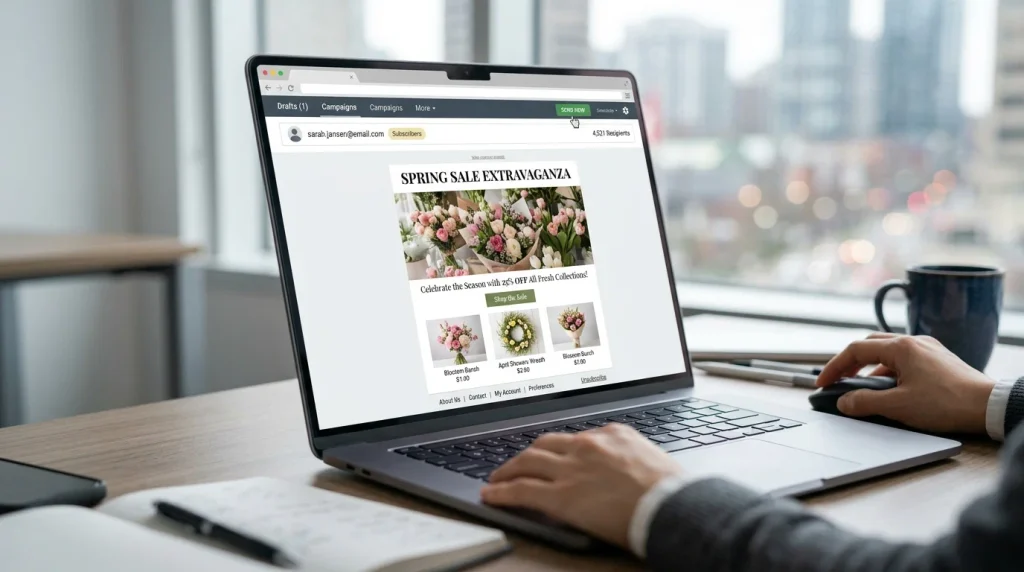
Use a broad send for information that has a clear deadline or universal relevance. Product launches, event registration deadlines, service changes, and seasonal promotions are common examples. Existing subscribers already understand the relationship and can quickly judge the offer.
A useful test is simple: ask whether most recipients would reasonably care today. If the answer depends heavily on location, purchase history, or industry, segment first. Relevance protects both performance and subscriber trust.
Some campaigns can also support word-of-mouth growth after the first click. BizVerra’s guide to viral marketing strategies explains how sharing and referrals can extend reach. Email can start that process when recipients already value the message.
When You Should Avoid a Broad Send
Avoid sending the same promotion to everyone when the audience contains unrelated groups. Customers in different provinces may need different offers, dates, or availability details. Business buyers may also expect different information from consumer subscribers.
Broad sends are also weak for welcome journeys, abandoned carts, renewals, and lead nurturing. Those moments depend on individual behaviour or timing. Automated messages can respond more precisely to each trigger.
The same principle applies to B2B communication. Business purchases often involve several people and longer decision cycles. BizVerra’s B2B sales guide explains how research, first contact, discovery, proposals, and negotiation fit together.
How to Send an Email Blast That People Want to Read
A strong broadcast starts before you write the subject line. List quality, audience relevance, and compliance affect everything that follows. Use the following process before pressing send.
- Define one objective. Decide whether you want a purchase, registration, booking, download, or another measurable action.
- Confirm who should receive it. Remove invalid contacts, unsubscribed addresses, and recipients without an appropriate basis for receiving the message.
- Segment where necessary. Separate groups by location, customer status, interests, or engagement when those differences affect relevance.
- Write one clear promise. Your subject line and opening should explain why the message matters now.
- Keep the body focused. Explain the benefit, provide enough supporting detail, and remove unrelated offers.
- Use one primary call to action. Tell readers exactly what you want them to do next.
- Test the message. Check links, mobile formatting, personalisation fields, spelling, sender details, and unsubscribe functionality.
- Schedule thoughtfully. Consider Canadian time zones rather than sending every message according to one local clock.
- Measure the result. Review clicks, conversions, revenue, complaints, bounces, and unsubscribes after delivery.
The process becomes easier when each send has one job. Several unrelated offers force readers to choose between competing actions. A focused message makes both reading and measurement simpler.
CASL and Commercial Email in Canada
Canadian businesses should understand CASL before sending promotional electronic messages. The federal government says consent sits at the centre of the legislation. Senders should also be prepared to prove the consent they rely upon.
The government distinguishes between express and certain forms of implied consent. Some implied-consent situations have time limits, including existing relationships and recent inquiries. Businesses should check the official CASL consent guidance for their circumstances.
Commercial messages also need identifying information and an unsubscribe mechanism. Government guidance says unsubscribe requests must be handled within 10 business days. Contact information included with the message must remain valid for at least 60 days.
Buying or harvesting addresses can create additional legal and reputation risks. The Office of the Privacy Commissioner provides separate e-marketing guidance covering electronic address collection. Businesses with unusual circumstances should obtain qualified legal advice.
A Four-Question Relevance Test Before Every Send
A simple pre-send test can stop weak campaigns before they reach thousands of inboxes. It focuses on relevance rather than vanity metrics. Answer all four questions before approving a broad broadcast.
- Would most people on this list understand immediately why they received this?
- Does the offer or information apply to most recipients right now?
- Can the purpose be explained in one clear sentence?
- Is there one obvious next action after reading?
Three or four positive answers usually support a broad send. One or two positive answers suggest stronger segmentation is needed. Zero positive answers indicate the message should probably be redesigned.
This check also prevents teams from treating list size as the main success measure. Ten thousand poorly matched recipients are not automatically better than two thousand interested subscribers. Relevance creates the conditions for clicks and conversions.
Writing Better Subject Lines and Email Copy
A subject line should tell readers what the message contains without hiding the point. Clear wording usually beats vague excitement or excessive punctuation. The message should also match the expectation created before the open.
Open with the benefit, deadline, change, or announcement that matters most. Keep supporting copy short enough for scanning on a phone. Government of Canada writing guidance similarly recommends concise emails with clear purposes and reader-focused structure.
Your call to action should use specific language. “Reserve your seat” gives clearer direction than “Learn more” when registration is the objective. The landing page should then continue the same promise without making readers search again.
Should You Segment a Broadcast?
Segmentation does not defeat the purpose of broad email. It can make one campaign more relevant while preserving efficient production. Even simple groups can prevent obvious mismatches.
A national retailer could separate subscribers by province when an offer varies regionally. A software company could separate current customers from prospects. A B2B company could divide recipients by industry when examples differ significantly.
Do not create segments without a reason. Every extra variation adds production and testing work. Segment only when the difference changes the offer, timing, message, or likely reader response.
Which Metrics Matter After Sending?
Open rates can provide directional information, but they should not define success alone. Privacy features and mailbox technology can affect how opens are recorded. Business outcomes provide a clearer picture of campaign value.
Track delivery rate and bounces first because they reveal list-quality problems. Then review clicks, conversions, unsubscribes, and spam complaints. Ecommerce businesses should connect those results to orders or revenue where possible.
Compare results against your previous sends rather than chasing one universal benchmark. Audiences, industries, list sources, and offers differ too much for one number to fit everyone. Testing subject lines, segments, offers, and timing creates a more useful internal benchmark.
Common Mistakes That Hurt Results
The first mistake is sending because a list exists rather than because subscribers need the message. Irrelevant volume can train people to ignore future emails. It can also increase unsubscribes and complaints.
Another mistake is treating every subscriber as identical. Location, purchase history, engagement, and customer status can change what matters. Basic segmentation can remove obvious sources of friction.
A final mistake is measuring activity without measuring outcomes. A campaign can generate attention while producing few sales or registrations. Define the desired business result before you send anything.
Frequently Asked Questions
What is an email blast?
It is a single message sent to many recipients during the same general sending period. Businesses commonly use broadcasts for promotions, announcements, launches, and event notices. Modern programmes often add basic segmentation to improve relevance.
Are mass marketing emails legal in Canada?
Commercial electronic messages can be legal when the applicable CASL requirements are met. Consent, sender identification, contact information, and unsubscribe requirements are important parts of compliance. Specific circumstances can change which rules apply, so official guidance should be checked.
Can I buy a Canadian email list and start sending?
Buying a list does not automatically give you valid permission to send commercial messages. Address harvesting and third-party lists can also create privacy and reputation risks. Review Canadian consent rules before using any acquired database.
How often should a business send promotional emails?
There is no universal frequency that fits every audience. Start with the amount of useful information you genuinely have to share. Monitor unsubscribes, complaints, clicks, and conversions as frequency changes.
What is the best time to send marketing email in Canada?
No single hour works for every Canadian audience. Customer behaviour, industry, time zone, and offer type all affect performance. Test several sending windows using your own subscriber data.
Make Every Send Earn Its Place in the Inbox
Broad email can still work because some messages genuinely matter to a large audience. The strongest campaigns combine permission, relevance, focused copy, and measurable business goals. Canadian companies also need compliance checks built into the process.
Before your next send, apply the four-question relevance test and review your recipient list. Then define one action you want readers to take. That discipline makes the campaign more useful for subscribers and easier for your business to measure.